> For the complete documentation index, see [llms.txt](https://docs.wandfi.io/llms.txt). Markdown versions of documentation pages are available by appending `.md` to page URLs; this page is available as [Markdown](https://docs.wandfi.io/products/ip-vault/dutch-vamm.md).
# Dutch-VAMM
## Bonding Curve of Pricing
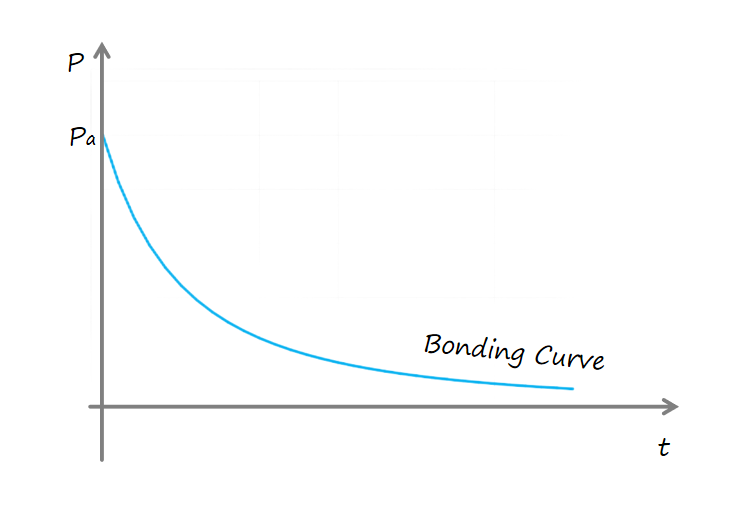
To achieve efficient price discovery, the price of YT will initially open at a higher level and then decrease at a certain rate until someone is willing to trade at that price. This is very similar to a Dutch auction. The bonding curve of pricing is given by:
$$P(t) = {P\_a}/{(1 + t )^2}$$
Where :
* $$P\_a$$ is the initial price of YT;
* $$t$$ is the time elapsed in the current epoch, measured in days.
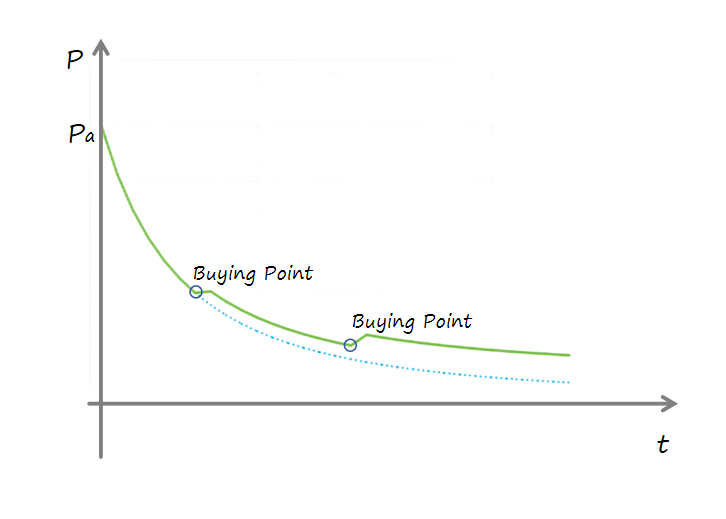
When a user buys YT, the price will experience a jump due to changes in the supply and demand dynamics. This is different from a standard Dutch auction. So the price decline appears as shown in the following chart.
## Virtual AMM
We draw inspiration from Uniswap's classic AMM mechanism to facilitate the purchase of YT. In our contract, we have virtually created a trading pair of YT and underlying assets, but only allow one-way purchasing of YT.
In a standard AMM, the relationship is
$$X \times Y =k$$
Where:
* $$X$$ is the number of YT;
* $$Y$$ is the number of underlying assets which is virtually generated by the contract. $$Y=P\_a\times X$$
* $$k$$ is a constant
Therefore, we can use the above formula to calculate how many YT (m) can be purchased with '𝑛' units of the underlying asset.
$$
(X - m) \times (Y + n) = k
$$
Then we can get
$$
m = X - \frac{k}{Y + n}
$$
However, because we have incorporated a Dutch auction-style Bonding Curve, $$k$$ in our VAMM is not constant but instead continuously decays over time.
$$
k(t) = {k\_0}/{(1 + t )^2}
$$
Where
* $$k\_0$$ is the constant at the beginning;
* $$t$$ is the time elapsed in the current epoch, measured in days.
Therefore, the final formula for calculating ‘𝑚’ is:
$$
m(t) = X - \frac{k\_0}{(Y + n)\times(1+t)^2}
$$