# Background

The tokenization of Real World Assets (RWA) is rapidly emerging as the new darling of the financial markets. By transforming tangible assets into easily tradable digital tokens, RWAs satisfy the market's demand for high liquidity and transparency. This approach offers investors novel ways to enter markets that typically require significant capital, such as real estate and fine art. Moreover, RWAs create a 24/7 trading market for traditional assets—a capability that conventional markets often struggle to achieve.\
In the decentralized finance (DeFi) space, RWAs present equally broad prospects. At its core, DeFi aims to build a permissionless, transparent, and efficient financial ecosystem, and the introduction of RWAs offers a new instrument to realize this vision. For example, tokenized U.S. Treasuries and private credit products are opening up fresh investment opportunities for DeFi users, delivering yield potentials that mirror those of traditional financial markets. Additionally, the integration of RWAs has spurred innovation in DeFi products, such as asset-backed lending platforms and yield farming, thereby providing more avenues for earning passive income.

\
As uncertainties in global financial markets grow, investors are increasingly seeking diversified portfolios. RWAs provide a novel entry point into traditional markets while preserving the agility inherent to the crypto market. These solutions deliver three key advantages: enhanced liquidity, improved financing options, and automated asset management through smart contracts. The growing demand for these benefits is propelling the expansion of the RWA market and drawing participation from both institutional and individual investors.

\
As more RWAs are tokenized, the demand for on-chain DeFi applications is also rising. The Wand Protocol, with its structured approach, is specifically designed to offer financial services for such assets. This includes products such as collateral-vaults, IP-vaults, and Yield-vault v2, among others.


# IP-Vault

On Story protocol, each IP Asset has an IP Royalty Vault, which acts as a pool for all monetary inflows related to an IP Asset's commercial exploration or from minting licenses. Royalty Tokens can be used to claim Revenue Tokens. Wand IP-Vault is a tailor-made structured product for Story Protocol Royalty Tokens.

IP-Vault is a Pendle-like protocol. Users deposit Royalty Tokens and receive Principal Tokens (PT) and Yield Tokens (YT). Holding PT signifies ownership of the principal, while YT represents all real-time yields from the underlying assets. Unlike Pendle, It is perpetual, allowing users to hold PT or YT indefinitely without expiration.

The IP-Vaults will be divided into epochs based on a fixed time cycle, with each subsequent epoch being generated only after the previous one ends. PT remains unchanged across different epochs. However, each epoch will have a uniquely numbered YT corresponding to that period.

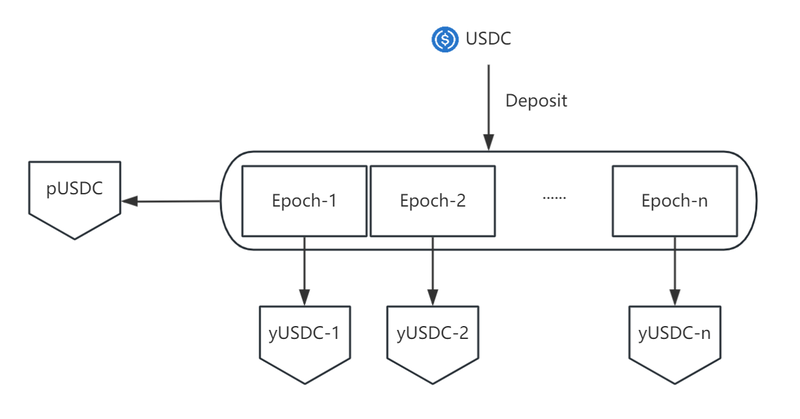
Let's use USDC as a Royalty Token example to explain the working mechanism of the IP-Vault.

<figure><img src="https://669798271-files.gitbook.io/~/files/v0/b/gitbook-x-prod.appspot.com/o/spaces%2FdP2GPddVCO37jH5cWj61%2Fuploads%2F5ufffbcEou0E9aw60H0a%2F%E6%97%A0%E6%A0%87%E9%A2%98.png?alt=media&amp;token=ebe4b1e3-5cbf-43f4-9efe-ef107d482443" alt=""><figcaption></figcaption></figure>

When users deposit USDC into the B-Vault, they receive pUSDC at a 1:1 ratio. pUSDC is a rebasable token that provides interest earnings in USDC. At the same time, yUSDC is also generated at a 1:1 ratio and temporarily held in the contract. Users need to pay USDC to purchase a certain amount of yUSDC. The USDC used to purchase yUSDC serves as the interest source for pUSDC and is distributed to pUSDC holders. Additionally, the IP-Vault earns Revenue Tokens, which are then distributed to yUSDC buyers.


# Principal Token

Principal Token (PT) is minted at a 1:1 ratio with the underlying assets. Holding PT signifies ownership of the principal and entitles the holder to interest earnings. The interest is distributed as a rebase, increasing the amount of PT the user holds.

Although the Vault is divided into multiple Epochs over time, PT holders do not need to take any action. The protocol will automatically continue at the end of each Epoch.

### Withdraw Underlying Assets <a href="#withdraw-underlying-assets" id="withdraw-underlying-assets"></a>

Users can initiate the process when they want to withdraw their underlying assets. Each PT corresponds to an equal amount of the underlying asset. Upon a successful request, users will not receive the underlying assets immediately; instead, they can view the amount being redeemed under 'Pending Requests'. After the current Epoch ends, users can then proceed with the claim.

PTs in 'Pending Requests' still accrue interest. A redemption fee is charged, and the default rate is 0.5%, which can be adjusted through governance in the future.


# Yield Token

Yield Token(YT) represents all real-time yields from the underlying assets. Each Epoch will generate YTs with different serial numbers, and these YTs can only claim the rewards corresponding to their specific Epoch.

### Buy YT <a href="#buy-yt" id="buy-yt"></a>

YT is not initially minted but is tracked by the contract. Users need to purchase YT in the contract to obtain it. The price of YT is determined by a bonding curve and a virtual AMM set by the contract. It fully accounts for supply and demand changes and incorporates a [Dutch auction mechanism](/products/ip-vault/dutch-vamm) for efficient price discovery.&#x20;

### Harvest Rewards <a href="#harvest-rewards" id="harvest-rewards"></a>

Due to the Dutch-VAMM mechanism, YT cannot be completely bought out by users, and some will remain in the contract. The YTs remaining in the contract do not participate in the reward distribution. As a result, the rewards earned by the YTs purchased by users are greater than the yield of the corresponding amount of underlying assets.

For example, there are a total of 100 underlying assets, initially generating 100 PTs and 100 YTs. All YTs are initially held in the contract. Throughout the Epoch, 50 YTs are bought by users, leaving 50 YTs in the contract. Since the 50 YTs remaining in the contract do not participate in the reward distribution, each YT held by users represents the yield of 2 underlying assets.

The rewards for YT holders are divided into two types:

* One type is distributed based on the holder's **YT Balance**, which is suitable for regular rewards.
* The other type is distributed based on the holder's **YT Points**, which is suitable for irregular rewards like one-time airdrops and bribes. YT Points are calculated based on the duration of YT holding. Users must click "Claim" to receive their corresponding YT Points.


# Dutch-VAMM

## Bonding Curve of Pricing

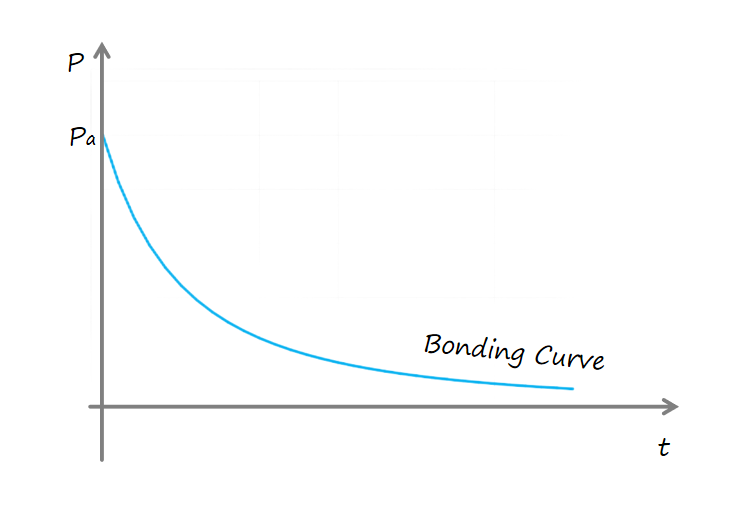
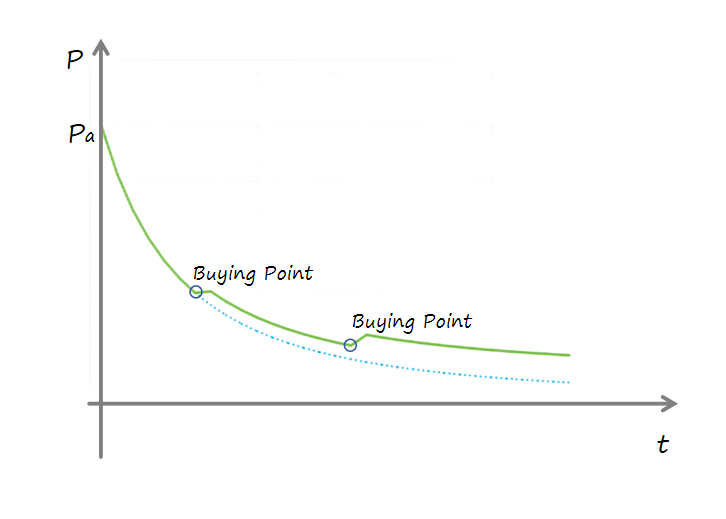
To achieve efficient price discovery, the price of YT will initially open at a higher level and then decrease at a certain rate until someone is willing to trade at that price. This is very similar to a Dutch auction. The bonding curve of pricing is given by:

&#x20;                                                                   $$P(t) = {P\_a}/{(1 + t )^2}$$

Where ：

* $$P\_a$$ is the initial price of YT;
* $$t$$ is the time elapsed in the current epoch, measured in days.

<figure><img src="https://669798271-files.gitbook.io/~/files/v0/b/gitbook-x-prod.appspot.com/o/spaces%2FdP2GPddVCO37jH5cWj61%2Fuploads%2FY3dM55XPsTlDbHKOUujK%2Fimage.png?alt=media&amp;token=e438f307-7cd1-432a-95cf-ef519afa109b" alt="" width="373"><figcaption></figcaption></figure>

When a user buys YT, the price will experience a jump due to changes in the supply and demand dynamics. This is different from a standard Dutch auction. So the price decline appears as shown in the following chart.

<figure><img src="https://669798271-files.gitbook.io/~/files/v0/b/gitbook-x-prod.appspot.com/o/spaces%2FdP2GPddVCO37jH5cWj61%2Fuploads%2F7Lup0z5FRkuSc9FSJK5L%2Fimage.png?alt=media&amp;token=093d523a-fca9-4b05-8b3e-0c01bffc2420" alt="" width="363"><figcaption></figcaption></figure>

## Virtual AMM

We draw inspiration from Uniswap's classic AMM mechanism to facilitate the purchase of YT. In our contract, we have virtually created a trading pair of YT and underlying assets, but only allow one-way purchasing of YT.

In a standard AMM, the relationship is&#x20;

&#x20;                                                                                 $$X \times Y =k$$

Where:

* $$X$$ is the number of YT;
* $$Y$$ is the number of underlying assets which is virtually generated by the contract.  $$Y=P\_a\times X$$
* $$k$$ is a constant

Therefore, we can use the above formula to calculate how many YT (m) can be purchased with '𝑛'  units of the underlying asset.&#x20;

$$
(X - m) \times (Y + n) = k
$$

Then we can get

$$
m = X - \frac{k}{Y + n}
$$

However, because we have incorporated a Dutch auction-style Bonding Curve, $$k$$ in our VAMM is not constant but instead continuously decays over time.&#x20;

$$
k(t) = {k\_0}/{(1 + t )^2}
$$

Where

* $$k\_0$$ is the constant at the beginning;
* $$t$$  is the time elapsed in the current epoch, measured in days.

Therefore, the final formula for calculating ‘𝑚’ is:

$$
m(t) = X - \frac{k\_0}{(Y + n)\times(1+t)^2}
$$


# Points Tracking

For regular on-chain reward claims, IP-Vault can handle them automatically. However, for rewards in the form of Points calculated off-chain, the following method is required for integration.

### Mechanism

IP-Vault comprises PT and YT. PT represents users’ shares of the underlying assets, while all additional rewards generated by these assets, such as profits or points, are fully distributed to YT users. Unlike Pendle’s mechanism, in IP-Vault, YT users’ rewards are determined by their YT share proportion, not the quantity.

### Points Tracking Method

This method applies to continuous point issuance, such as protocols that distribute points based on TVL daily or per hour/block. IP-Vault’s TVL earns points in the protocol’s system, and these points should be passed through to users, not retained by IP-Vault. The implementation is as follows:

* Wand provides a JSON file

&#x20;      **<https://story-api.wandfi.io/api/third/points/>**<mark style="color:red;">**:vaultaddress**</mark>**/**<mark style="color:red;">**:block**</mark>

* Inputs the relevant parameter to query the JSON file for the user list and their YT balances at that block. The data structure is as follows:

&#x20;    **{ data: { address: string, balance: string }\[], timestamp: number}**

&#x20;      Abnormal state description:

&#x20;      400: Vault not started

&#x20;      404: Vault has not been created in this block yet

&#x20;      500: Needs to wait for server indexing data

* Sum all **YT balances** to calculate the total **YT Amount**.
* Calculate a user’s **YT Share**:&#x20;

&#x20;      **YT Share = User’s YT Balance /  YT Amount**

* Determine the Total Points allocated to IP-Vault for the period.
* Calculate points for each user:

&#x20;      **User Points = Total Points × YT Share**

* Repeat these steps for each point issuance period, accumulating user points over time.

{% hint style="info" %}
Example

A protocol distributes points daily at 12:00 UTC.

* Day 1: IP-Vault is allocated 1,000 points.
* Input the block parameter to query the JSON file, retrieving YT balances for all users, including Alice.
* Calculate Alice’s YT Share, e.g., 1%.
* Allocate 10 points (1,000 × 1%) to Alice for Day 1.
* Day 2: More users buy YT, diluting Alice’s YT Share to 0.5%.
* IP-Vault is allocated 1,200 points for Day 2.
* Alice earns 6 points (1,200 × 0.5%) for Day 2.
* By the end of Day 2, Alice has accumulated 16 points.
  {% endhint %}


# Yield-Vault V2

Yield-vault V2 is a yield trading product that upgrades from the IP-Vault. Yield trading allows users to achieve yield enhancement, interest rate arbitrage, and other functionalities by purchasing yield rights with a small amount of capital. The underlying asset of the yield trading product is a single asset. By standardizing and splitting the underlying asset into Principal Tokens (PT) and Yield Tokens (YT), the product separates principal and yield rights. This enables liquidity provision with a single underlying asset. Additionally, for assets with long-term yields, the product can be renewed to maintain continuous liquidity, offering convenience to users. Traditional Automated Market Maker (AMM) pools require initial liquidity injection to ensure a smooth trading experience, which imposes capital requirements during pool establishment. B-vault V2 introduces **Zero Liquidity Bootstrap**, allowing users to launch a vault with minimal upfront capital while maintaining trading efficiency.


# Glossary

* **PT (Principal Token)**: Represents the principal capital of the yield trading product.
* **YT (Yield Token)**: Represents the yield portion of the yield trading product.
* **BT (Base Token)**: A standardized, wrapped version of the underlying asset.
* **Maturity**: The time of the product's maturity.
* **Proportion**: The ratio of PT assets in the pool.
* **Price**: The exchange rate of BT to PT.


# Innovations

1. **Single-asset delta neutrality**, compared to designs using PT/SY or YT/SY trading pairs, maintains **delta** **neutrality** for liquidity providers.
2. **Single-sided liquidity,** improves the capital efficiency of the PT/SY model.
3. **Continuous liquidity**, enabling perpetual operation of the asset pool.
4. **Uniswap V4 Hook integration** , implementing customized AMM by integrating Uniswap V4 Hook.
5. **Zero Liquidity Bootstrap**, eliminating the need for upfront liquidity injection during pool initialization.


# User Interaction

1. **Users purchase PT**: PT is discounted relative to BT (Base Token) and can be redeemed 1:1 for BT upon maturity.
2. **Users purchase YT**: YT holders continuously receive yield until maturity.
3. **Liquidity Providers (LPs):** deposit a single underlying asset to provide liquidity for market-making.


# Product Description

Yield swap is a specialized transaction. While Pendle uses traditional AMM mechanisms to create PT/SY trading pairs for yield swaps, Yield-vault V2 improves the algorithm to enhance capital efficiency and user experience.


# Single-Asset Liquidity Pool

Yield-vault V2 uses a single-asset liquidity pool. Liquidity Providers (LPs) only need to deposit a single asset (BT) to provide liquidity. Unlike other AMM products that allow single-asset deposits or withdrawals post-pool creation, B-vault V2 requires only BT during initial pool establishment. During redemption, LPs may receive BT and PT or BT and YT, depending on pool conditions. Subsequent liquidity additions still require only BT.

\
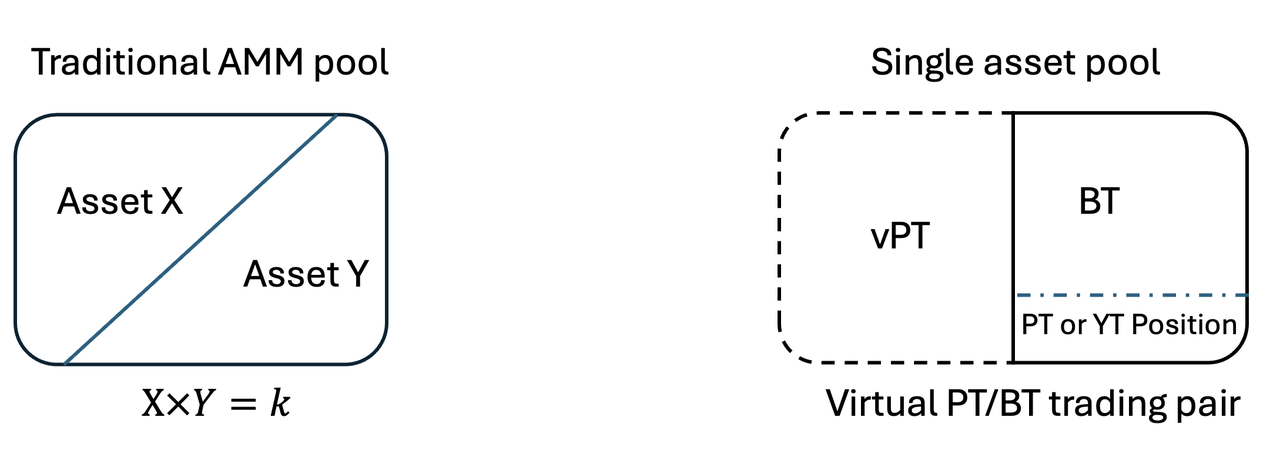
The protocol virtually creates a PT/BT trading pair. For example, if the initial liquidity is 1000 BT, the contract virtually generates 1000 PT to form an AMM pool, equivalent to a traditional 1000 BT/1000 PT pool.

<figure><img src="https://669798271-files.gitbook.io/~/files/v0/b/gitbook-x-prod.appspot.com/o/spaces%2FdP2GPddVCO37jH5cWj61%2Fuploads%2Fq0mxxaNZV7rvtiph6JyA%2Fimage.png?alt=media&amp;token=654a7251-64cc-4a03-959d-447ba7f46392" alt="" width="563"><figcaption></figcaption></figure>

### **Trading Mechanism**:

* When a user buys PT, they deposit BT into the pool and receive virtual PT (vPT), which is converted 1:1 to PT.
* When a user sells PT, the contract burns PT to generate vPT, which is exchanged for BT from the pool.
* Customized AMM is achieved by integrating the Uniswap v4 hook. Users can complete transactions through Uniswap's ecological tools


# Liquidity Provision

LPs only deposit BT. For example:

* **Initial deposit**: 100 BT generates 100 vPT, forming the pool. LPs receive LP Shares.
* **Redemption**: LPs withdraw BT, and vPT is burned. If the vPT/BT ratio changes, the redemption logic adjusts accordingly.

### **Key Formulas**:

* Total BT in pool:     $$BT\_{tp}$$
* Net BT:        $$BT\_{net} = \text{Min}\left\[{BT}*{tp}, {BT}*{tp} - ({PT}\_c - {YT}\_c)\right]$$
* Net assets:    $$A\_{net} = \text{Max}\left\[{BT}*{tp}, {BT}*{tp} - ({PT}\_c - {YT}\_c)\right]$$

### **Scenario 1**:

When $${PT}\_c \geq {YT}\_c$$&#x20;

* LPs receive PT and LP Shares proportional to their BT deposit:

$$
dPT = \frac{{PT}c - {YT}c}{A{net}} \times dBT, \quad dShare = \frac{{Share}{total}}{A\_{net}} \times dBT
$$

* Redemption yields BT and YT:

$$
dBT = \frac{dShare \times {BT}{net}}{{Share}{total}}, \quad dYT = \frac{dShare \times ({PT}\_c - {YT}c)}{{Share}{total}}
$$

### **Scenario 2**:&#x20;

When $${PT}\_c < {YT}\_c$$&#x20;

* LPs receive YT and LP Shares:

$$
dYT = \frac{{YT}c - {PT}c}{A{net}} \times dBT, \quad dShare = \frac{{Share}{total}}{A\_{net}} \times dB
$$

* Redemption yields BT and PT:

$$
dBT = \frac{dShare \times {BT}{net}}{{Share}{total}}, \quad dPT = \frac{dShare \times ({YT}\_c - {PT}c)}{{Share}{total}}
$$

### **Proportionality Principle**:

$$
\text{Proportion} = \frac{{BT}{tp}}{vPT}, \quad \text{Proportion}*{\text{after}} = \text{Proportion}*{\text{before}}
$$

### **Instant Mode**

Instant Mode allows users to deposit BT to acquire LP shares without receiving PT or YT in return. Users who prefer simplified operations can opt for this mode. The underlying mechanism converts all PT or YT that the user would otherwise receive into BT, which is then injected into the liquidity pool. This process triggers a swap transaction for the user.


# Pricing Mechanism

The price formula is:

$$
\text{price}(t) = \frac{1}{\text{rateScalar}(t)} \times \ln\left(\frac{p(t)}{1 - p(t)}\right) + \text{rateAnchor}(t)
$$

* **Normalized time ( t )** ranges from 0 (maturity) to 1.
* **rateScalar**:  rateScalar(t) = ScalarRoot / t, adjusts dynamically to maintain capital efficiency.
* **rateAnchor:** rateAnchor(t) = 1 + (InitialAnchor - 1) \* t, adjusts the expected discount between PT and BT.

**Example**:

Given$$( \text{rateScalar} =100)$$, $$( \text{rateAnchor} = 1.1 )$$， initial PT proportion $$( p\_{\text{before}} = 0.6 )$$

$$
\text{price}\_{\text{before}} = \frac{1}{100} \times \ln\left(\frac{0.6}{0.4}\right) + 1.1 = 1.104055
$$

After swapping 100 BT for PT, assuming  $$p\_{\text{after}} = 0.55$$

$$
\text{price}\_{\text{after}} = \frac{1}{100} \times \ln\left(\frac{0.55}{0.45}\right) + 1.1 = 1.102007
$$

$$
dPT = 100 \times \frac{1.104055 + 1.102007}{2} = 110.3031
$$


# Implied  APY

The implied APY is calculated as:

$$
Implied APY= \text{Price}(t\_0)^{\frac{1}{T\_{\text{yearstoexpiry}}}} - 1
$$

For example, if $$( \text{Price}(t\_0) = 1.2 )$$ and $$( T\_{\text{yearstoexpiry}} = 0.5 )$$

$$
Implied APY= 1.2^{2} - 1 = 0.44
$$


# Renewable Liquidity

At maturity:

* If $$({PT}\_c \geq {YT}\_c)$$, excess BT  $$({PT}\_c - {YT}\_c)$$ will be transferred to the maturity pool.
* If $$({PT}\_c < {YT}\_c)$$, deficit BT  $$({YT}\_c - {PT}\_c)$$ will be replenished from the BT vault pool

LP Shares remain valid indefinitely. Upon renewal, new PT and YT tokens are issued, and the vPT will map to the new PT. The vPT pool resets to a 1:1 ratio with BT.


# Zero Liquidity Bootstrap

During initialization, the contract enters a bootstrap phase where administrators can inject incentive funds to attract LPs, accelerating liquidity bootstrapping. At this phase, the LPs can not remove their liquidity.

\
After the bootstrap phase, the vault starts to work normally.


# Points Tracking

Rewards in the form of Points calculated off-chain, the following method is required for integration.

### Mechanism

Yield-Vault comprises PT, YT, BT, and LP.&#x20;

* Principal Token (PT): Users receive a fixed yield in exchange for no yield and points.
* Yield Token(YT): 1 YT receives the yields and points generated by 1 underlying asset.
* Base Token(BT): :1 BT receives the yields and points generated by 1 underlying asset.
* Liquidity Providers(LP): Since LP is made up of BT + YT + PT, users will also receive some points exposure from the BT and YT in the LP

For developers, there's no need to analyze the complex mechanisms here; simply follow the methods below to complete the integration.

### Points Tracking Method

This method applies to continuous point issuance, such as protocols that distribute points based on TVL daily or per hour/block. Yield-Vault’s TVL earns points in the protocol’s system, and these points should be passed through to users, not retained by Yield-Vault. The implementation is as follows:

* Wand provides a JSON file

&#x20;      Based on block: **<https://api.wandfi.io/api/v2/third/points>**<mark style="color:red;">**/:vaultaddress/:block**</mark>                                 &#x20;

&#x20;      Based on timestam&#x70;**:   <https://api.wandfi.io/api/v2/third/points>**<mark style="color:red;">**/:vaultaddress/timestamp/:timestamp**</mark>

* Inputs the relevant parameter to query the JSON file for the user list and their balances. Wand has standardized the holdings of BT, YT, and LP users' underlying assets into a unified balance. The data structure is as follows:

&#x20;    **{ data: { address: string, balance: string }\[], timestamp: number}**

&#x20;      Abnormal state description:

&#x20;      400: Vault not started

&#x20;      404: Vault has not been created in this block yet

&#x20;      500: Needs to wait for server indexing data

#### Method 1

The sum of these Balances represents the underlying assets held by the Vault, and you can directly use the Balance data to calculate use's points according to your rules.

#### Method 2

First, calculate the Vault's points based on your rules, then allocate them to users proportionally. The calculation process for this method is as follows:

* Sum all **Balances** to calculate the total **Amount**.
* Calculate a user’s **Share**:&#x20;

&#x20;      **User's** **Share = User's Balance /  Amount**

* Determine the Total Points allocated to Vault for the period.
* Calculate points for each user:

&#x20;      **User's Points = Total Points × User's Share**

* Repeat these steps for each point issuance period, accumulating user points over time.

{% hint style="info" %}
Example

A protocol distributes points daily at 12:00 UTC.

* Day 1: Vault is allocated 1,000 points.
* Input the block or timestamp parameter to query the JSON file, retrieving balances for all users, including Alice.
* Calculate Alice’s Share, e.g., 1%.
* Allocate 10 points (1,000 × 1%) to Alice for Day 1.
* Day 2: More users come in, diluting Alice’s Share to 0.5%.
* Vault is allocated 1,200 points for Day 2.
* Alice earns 6 points (1,200 × 0.5%) for Day 2.
* By the end of Day 2, Alice has accumulated 16 points.
  {% endhint %}


# Collateral-Vault


# Core Concept

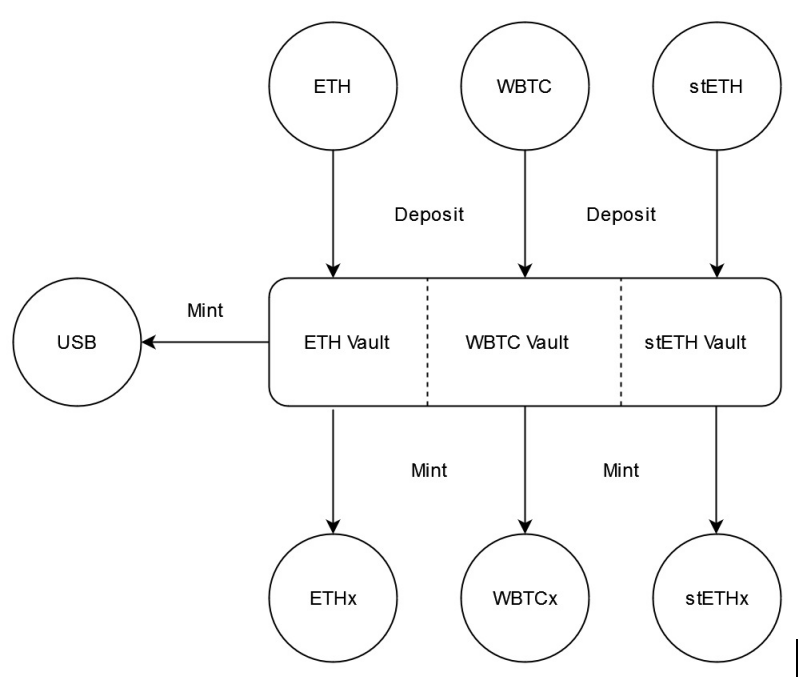
In the standard CDP model, the collateral you provide is limited to producing stablecoins like DAI. Wand, on the other hand, diversifies the potential of your collateral, allowing it to create two distinct asset types:

* USB — Stablecoin;
* xToken — Margin Token, signifying your long position in the respective collateral.


# USB-Stablecoin

## What is USB?

Like the DAI in the MakerDAO protocol, USB(Universal Stable Basis) is a decentralized, asset-backed circulating token designed with a price using Oracle feeds, serving as a soft peg to the US dollar.

## How to Obtain USB?

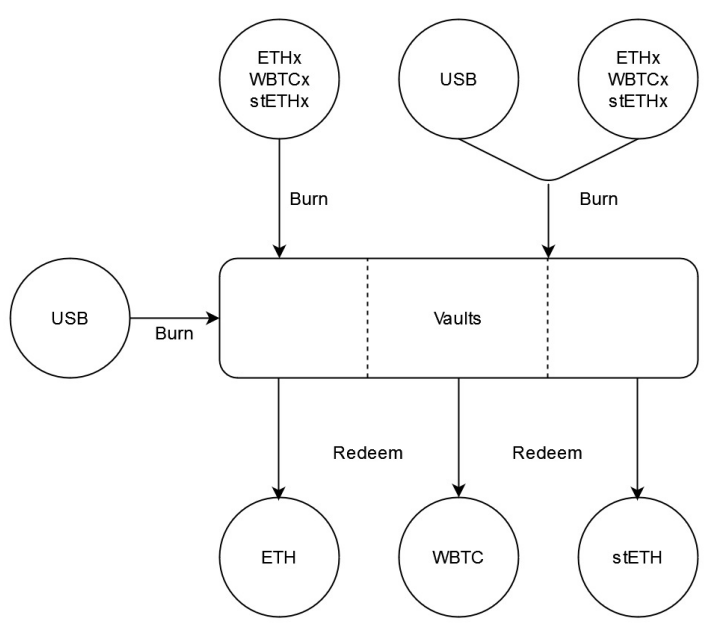
USB is minted through the process of depositing collateral into the Vault. The protocol supports a variety of assets for minting USB. Conversely, holding USB grants users the ability to redeem their collateral from the Vault, with each USB token representing $1 worth of collateral. This design effectively ties the value of USB to the US dollar, ensuring its stability and reliability as a medium of exchange.

## Where do the earnings come from?

USB is a rebasable, interest-bearing stablecoin, generating earnings through:

* **Blast Native Yield:** A feature exclusive to the Blast network.
* **Financing Interest:** Paid by holders of margin tokens.

To receive the aforementioned earnings, users simply need to hold USB. Furthermore, USB can be utilized to engage in  [PTY--Price Trigger Yield](/products/collateral-vault/earn/pty-price-trigger-yield) for farming, as well as earn arbitrage profits from the [Discount Offer](/products/collateral-vault/discount-offer).

<br>


# xToken-Margin Token

## What is a Margin Token？

A margin token is a type of crypto asset to represents an open position. Essentially, when an investor wants to open a leveraged position—meaning they want to borrow funds to increase their exposure to an asset—they can do so by acquiring margin tokens.

For example, holding a margin token might signify that you have a position that is 2x or 3x the value of the collateral in the vault. This allows for potentially higher gains if the collateral's value increases, but it also comes with increased risk, as the losses are also magnified if the collateral's value decreases.

Margin tokens enable these open positions to be managed in a decentralized manner, without the need for an intermediary. It can be traded, bought, and sold like other tokens, and the value is linked to the performance of the collateral and the leverage level it represents. This makes it a powerful tool for sophisticated trading strategies in DeFi.<br>

## How to Obtain Margin Tokens?

Margin tokens are minted through the deposit of collateral, with all supported assets eligible for minting their respective margin tokens. Each type of collateral is associated with a specific margin token. For instance, ETH correlates with the margin token ETHx, while WBTC correlates with the margin token WBTCx. Holding margin tokens grants the ability to redeem collateral from the Vault. Nevertheless, the method of redemption may differ based on the current state of the protocol.

## Advantages of Margin Tokens

Margin tokens offer several advantages compared with derivative trading.

* **No Margin Deposits Required:** Eliminates the need for margin deposits, significantly lowering the entry barrier for investors.
* **No Liquidation Risk:** Offers peace of mind and stability, as there's no risk of liquidation in the investment strategy.
* **Auto-Balanced Leverage Ratio:** Ensures sustainable positions without the need for constant monitoring, as the leverage ratio is automatically balanced.
* **High Composability in DeFi:** Allows integration with various financial instruments and strategies within the DeFi ecosystem.
* **Trade Like Spot Assets:** Margin tokens can be traded just like spot assets, combining the familiarity of traditional trading with the benefits of leverage.
* **Redeemable for Open Position:** Investors can claim the open position at any time, providing flexibility and control over their investments.
* **Lower Financing Costs:** Typically have lower financing costs compared to derivatives, making them a more cost-effective option for leveraging.
* **Transparency and Security:** Features inherent transparency and security thanks to blockchain technology.
* **Suitable for All Investor Levels:** Cater to both new entrants and experienced traders, offering efficient capital use and risk management.


# Vault

In traditional over-collateralization models, users typically operate individual vaults, each generating its Collateralized Debt Position (CDP). Wand, however, innovates by aggregating vaults, which harmonizes the assets minted and obviates the necessity for singular liquidations. Within this aggregated structure lies a pooled CDP that encapsulates all circulating margin tokens, with the debt acknowledged as collective. Consequently, every margin token holder assumes a proportional share of this communal debt.&#x20;

Wand employs the Asset Adequacy Ratio (AAR) as a metric to gauge the health of the vault. A heightened AAR diminishes the leverage ratio applicable to margin tokens. Conversely, a diminished AAR indicates potential debt repayment risks associated with USB. Thus, maintaining the AAR balance is crucial.

In the Wand protocol, there are two types of vaults:  [V-Vault](/products/collateral-vault/vault/v-vault) for volatile assets, such as ETH and WBTC, and [S-Vault](/products/collateral-vault/vault/s-vault) for stable assets, like USDC and USDB. Additional vaults can be established as the range of accepted collateral types expands.&#x20;

{% hint style="info" %}
Each vault mints the same USB, which can be used in the same scenarios, though the specific margin tokens minted by each will vary.
{% endhint %}


# AAR--Asset Adequacy Ratio

AAR--Asset Adequacy Ratio signifies the capability of the protocol vault to cover the USB debt. It is used to assess the vault's health. Below is the calculation for AAR, taking the ETH vault as an example.

***

## Calculation of AAR

The AAR for ETH vault is calculated as follows:

$$
AAR\_{eth} = \frac{M\_{ETH} \times P\_{eth}}{M\_{USB-ETH}} \times 100%
$$

Where:

* $$M\_{ETH}$$ is the amount of ETH in the vault.
* $$P\_{eth}$$ is the current price of ETH, obtained from the oracle.
* $$M\_{USB-ETH}$$ is the amount of USB minted from the ETH vault.

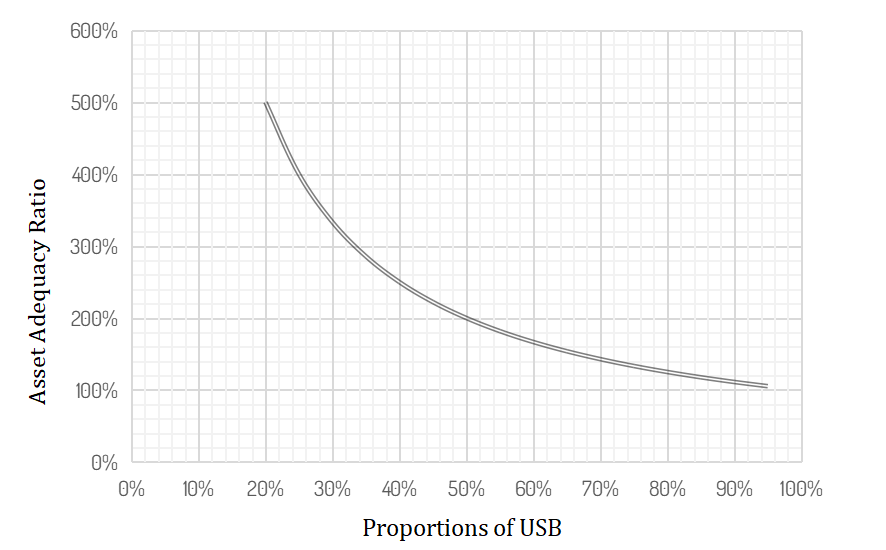
A negative correlation exists between the AAR and the proportion of USB within the protocol vault:

<figure><img src="https://669798271-files.gitbook.io/~/files/v0/b/gitbook-x-prod.appspot.com/o/spaces%2FdP2GPddVCO37jH5cWj61%2Fuploads%2FO4Qcx1GjPaZ7ZsPPTpUb%2Fimage.png?alt=media&amp;token=9d5c1c39-4308-4445-b4b9-e3641a393780" alt="" width="375"><figcaption><p>Figure : Corresponding relationship between the AAR and Proportions of USB</p></figcaption></figure>

***

## Thresholds of AAR

* **AART**: Target AAR

  Target AAR represents the ideal state of the vault.
* **AARS**: Safety AAR

  When below the Safety AAR, the pool's ability to repay USB debt is at risk.
* **AARU**: Upper AAR

  When above the Upper AAR, the leverage ratio of Margin tokens becomes less attractive.&#x20;

The thresholds of AAR for each vault can be set individually.&#x20;

{% hint style="warning" %}
S-Vault only has AARS.
{% endhint %}

## AAR Rebalancing

Unlike traditional lending protocols, Wand does not enforce liquidations. Instead, it introduces an Adjustment mode, [PTY--Price Trigger Yield](/products/collateral-vault/earn/pty-price-trigger-yield) and a [Discount Offer](/products/collateral-vault/discount-offer) mechanism to dynamically adjust the AAR. This allows anyone to participate and potentially earn arbitrage profits, ensuring the Vault's health.


# V-Vault


# Deposit for minting

Depositing collateral into the vault can mint both USB and margin tokens.

<figure><img src="https://669798271-files.gitbook.io/~/files/v0/b/gitbook-x-prod.appspot.com/o/spaces%2FdP2GPddVCO37jH5cWj61%2Fuploads%2FH331xj72TL3RbepIv1Du%2Fimage.png?alt=media&amp;token=ce37a5cb-a0e5-4def-8f98-01fc6fc21ee8" alt="" width="375"><figcaption><p>Figure: Mint Process</p></figcaption></figure>

The V-Vault operates in two modes, starting initially with the stability mode, when the Vault's AAR deviates below the set lower limit (Safety AAR, AARS) or exceeds the upper limit (Upper AAR, AARU), the protocol enters an adjustment phase.&#x20;

Taking the ETH vault as an example:

***

## Stability Mode

When assets are first deposited into the Vault for minting, as the quantities of existing USB and ETHx are zero, we calculate the minting ratio based on the initial price P\_(eth-i) and then maintain this minting ratio unchanged throughout the stability phase. The protocol records the quantity of USB minted in each Vault, and the total supply of USB is the sum of USB minted across all Vaults.

**When the contract is initially created,** USB and ETHx are generated in a fixed ratio. The specific quantities and ratios are calculated using the following formula:

$$\Delta USB = \Delta ETH \times P\_{eth-i} \times \frac{1}{AART\_{eth}}$$

$$\Delta ETHx = \Delta ETH \times \left(1 - \frac{1}{AART\_{eth}}\right)$$

Where:

* $$\Delta USB$$ : The quantity of minted USB.
* $$\Delta ETHx$$: The quantity of minted ETHx.
* $$\Delta ETH$$: The quantity of ETH used for minting.
* $$P\_{eth-i}$$: The initial price of ETH relative to USD (provided by an oracle).&#x20;
* $$AART\_{eth}$$: The protocol's target AAR (Asset Adequacy Ratio) for the ETH vault.

**After the initiation, when depositing into the ETH vault**, users can mint USB and ETHx in a fixed ratio. The formulas for calculating the minted amounts are as follows:

$$\Delta USB = \Delta ETH \times \frac{M\_{USB-ETH}}{M\_{ETH}}$$

$$\Delta ETHx = \frac{\Delta USB \times M\_{ETHx}}{M\_{USB-ETH}}$$

{% hint style="info" %}
**Example：**

We assume ( AART\_{eth} = 150% ). When 2 ETH are first deposited into the Vault, and the real-time market price of ETH at that time is $2000, then:

$$\Delta USB = \Delta ETH \times P\_{eth-i} \times \frac{1}{AART\_{eth}} = 2 \times 2000 \times 0.6667 = 2666.7;$$

$$\Delta ETHx = \Delta ETH \times \left(1 - \frac{1}{AART\_{eth}}\right) = 2 \times 0.3333 = 0.6667$$&#x20;

If another user deposits 1 ETH into the Vault, assuming the market price of ETH is $2200, and the protocol is still in the stability phase, the user can obtain ( \Delta USB ) and ( \Delta ETHx ) as follows:

$$\Delta USB = \Delta ETH \times \frac{M\_{USB-ETH}}{M\_{ETH}}=1 \times \frac{2666.7}{2}=1333.4$$

$$\Delta ETHx = \frac{\Delta USB \times M\_{ETHx}}{M\_{USB-ETH}} =\frac{1333.4 \times 0.6667}{2666.7}=0.3334$$&#x20;

In this scenario, with a total of 3 ETH in the Vault, the Vault has generated a total of 4000 USB and 1 ETHx.
{% endhint %}

From the examples provided above, we can observe that within the protocol's stability phase, the number of USB and ETHx generated for each ETH deposited remains constant.

***

## Adjustment Mode

When the Vault's AAR deviates below the set lower limit (Safety AAR, AARS) or exceeds the upper limit (Upper AAR, AARU), the protocol enters an adjustment phase. During this adjustment phase, the method of asset minting changes.

**When AAR rises above AARU,** users can mint USB individually. The corresponding minting formula is as follows:

$$\Delta USB = \Delta ETH \times P\_{eth}$$

{% hint style="warning" %}
If users want to mint ETHx, they still need to mint USB+ETHx according to the protocol's calculated ratio.
{% endhint %}

**When AAR falls below AARS**, users can mint ETHx alone using the underlying asset. The minting formula in this case is:

$$\Delta ETHx = \frac{\Delta ETH \times P\_{eth} \times M\_{ETHx}}{M\_{ETH} \times P\_{eth} - M\_{USB-ETH}}$$

**When AAR further drops below 101%**, the formula for minting ETHx alone will change to:

$$\Delta ETHx = \frac{\Delta ETH \times P\_{eth} \times M\_{ETHx} \times 100}{M\_{USB-ETH}}$$

Where:

* $$\Delta USB$$ : The quantity of USB minted.
* $$\Delta ETHx$$: The quantity of ETHx minted.
* $$\Delta ETH$$: The quantity of ETH used for minting.
* $$P\_{eth}$$: The real-time price of ETH relative to USD (provided by the oracle).
* $$M\_{ETH}$$: The quantity of ETH in the Vault.
* $$M\_{ETHx}$$: The quantity of ETHx minted in the ETH Vault.
* $$M\_{USB-ETH}$$: The quantity of USB already minted in the ETH Vault.

{% hint style="warning" %}
If users want to mint USB, they still need to mint USB+ETHx according to the protocol's calculated ratio.
{% endhint %}

When Vault's AAR returns to AART, the protocol returns to the Stability Mode, and the asset minting formula reverts to the calculation used during the stability phase.


# Withdraw for redemption

The protocol's asset redemption mechanism also consists of two modes: the stability phase and the adjustment phase.

<figure><img src="https://669798271-files.gitbook.io/~/files/v0/b/gitbook-x-prod.appspot.com/o/spaces%2FdP2GPddVCO37jH5cWj61%2Fuploads%2FnhQHDM5sIeBmxlqmARCc%2Fimage.png?alt=media&amp;token=1f3150b7-c947-4214-ad0c-8878ba0cd61e" alt="" width="360"><figcaption><p>Figure: Redemption Process</p></figcaption></figure>

***

## Stability Mode

During the stability phase, users must hold a fixed ratio of USB and ETHx to redeem the corresponding ETH from the Vault. For example, if a user wishes to redeem a certain amount of ETHx, they need to pair it with the corresponding quantity of USB, and vice versa. The calculation formula is as follows:

$$\Delta USB = \frac{\Delta ETHx \times M\_{USB-ETH}}{M\_{ETHx}}$$

The amount of ETH redeemed with the paired ( \Delta ETHx ) and ( \Delta USB ) is:

$$\Delta ETH = \frac{\Delta ETHx \times M\_{ETH}}{M\_{ETHx}}$$

{% hint style="info" %}
**Example:**

Based on the data from the previous example, where there are a total of 7 ETH in the Vault, the protocol has generated 9333.8 USB, and 2.3333 ETHx, when a user wishes to redeem 1 ETHx, they need to accompany it with USB for redemption. The required amount of USB to accompany the redemption is:

$$\Delta USB = \frac{\Delta ETHx \times M\_{USB-ETH}}{M\_{ETHx}} = \frac{1 \times 9333.8}{2.3333} = 4000$$

Then, the amount of ETH to redeem when accompanying 1 ETHx with 4000 USB for redemption (assuming no transaction fees) is:

$$\Delta ETH = \frac{\Delta ETHx \times M\_{ETH}}{M\_{ETHx}} = \frac{1 \times 7}{2.3333} \times 1 = 3$$
{% endhint %}

***

## Adjustment Mode

When the protocol enters the adjustment phase, the user redemption rules change. If AAR rises above AARU, users can redeem ETHx alone. The redemption quantity calculation formula is as follows:

$$\Delta ETH = \frac{\Delta ETHx \times (M\_{ETH} \times P\_{eth} - M\_{USB-ETH})}{M\_{ETHx} \times P\_{eth}}$$

If AAR falls below AARS, users can redeem USB alone, and the quantity calculation formula is as follows:

$$\Delta ETH = \frac{\Delta USB}{P\_{eth}}$$

In the extreme scenario where AAR falls below 100%, the USB redemption mechanism is as follows:

$$\Delta ETH = \frac{\Delta USB \times M\_{ETH}}{M\_{USB-ETH}} \quad \text{if AAR} < 100%$$

Excluding the two situations mentioned above, users still need to pair two assets together for redemption.

{% hint style="warning" %}
The redemption fee is 0.5%
{% endhint %}


# S-Vault

The minting and redemption mechanism for the S-Vault is different because the price volatility of the stablecoin is low, so its mechanism is simpler compared to V-Vaults. Simply put, USB and xToken can mostly be minted and redeemed independently.&#x20;

Taking the USDB vault as an example:

***

## Deposit for minting

**When the contract is initially created or when the supply of USDBx is zero**, USB cannot be minted directly. The first time USDB assets are deposited into the contract to mint USDBx, we preset the initial minting amount with the formula:

$$\Delta USDBx = \Delta USDB$$

**After the initiation, when depositing into the USDB vault**, users can mint USB or USDBx independently. The formulas for calculating the minted amounts are as follows:

$$\Delta USB = \Delta USDB \times P\_{usdb}$$

$$\Delta USDBx = \frac{\Delta USDB \times P\_{usdb} \times M\_{USDBx}}{M\_{usdb} \times P\_{usdb} - M\_{USB-USDB}}$$

Where:

* $$\Delta USB$$: The amount of USB minted
* $$\Delta USDBx$$: The amount of USDBx minted
* $$\Delta USDB$$: The amount of USDB deposited
* $$P\_{usdb}$$: The price of USDB in terms of USD (assumed to be stable)
* $$M\_{usdb}$$: The total amount of USDB in the vault
* $$M\_{USDBx}$$: The total amount of USDBx minted
* $$M\_{USB-USDB}$$: The amount of USB minted from the USDB vault

**When the AAR falls below AARS**, USB can no longer be minted independently. If users need to mint USB, USDBx will be minted at the same time in proportion, according to the following formula:

$$\Delta USB = \Delta USDB \times \frac{M\_{USB-USDB}}{M\_{USDB}}$$

$$\Delta USDBx = \frac{\Delta USB \times M\_{USDBx}}{M\_{USB-USDB}}$$

**When AAR further drops below 101%**, the formula for minting USDBx alone will change to:

$$\Delta USDBx = \frac{\Delta USDB \times P\_{usdb} \times M\_{USDBx} \times 100}{M\_{USB-USDB}}$$

***

## Withdraw for redemption

**When redeeming USDB using USB**, the formulas based on the Asset Adequacy Ratio (AAR) are as follows:

$$\Delta USDB = \frac{\Delta USB}{P\_{usdb}}    \quad \text{if AAR} ≥ 100%%$$

$$\Delta USDB = \frac{\Delta USB \times M\_{USDB}}{M\_{USB-USDB}}\quad \text{if AAR} < 100%$$

Where:

* $$\Delta USB$$: The amount of USB being redeemed
* $$\Delta USDB$$: The amount of USDB to be received
* $$P\_{usdb}$$: The price of USDB
* $$AAR$$: The Asset Adequacy Ratio of the USDB vault
* $$M\_{USDB}$$: The total amount of USDB in the vault
* $$M\_{USB-USDB}$$: The amount of USB minted from the USDB vault

**When redeeming USDB using USDBx**, the calculation formula is as follows:

$$\Delta USDB =\frac{M\_{usdb} \times \Delta USDBx}{M\_{USDBx}}- \frac{M\_{USB-USDB} \times \Delta USDBx}{M\_{USDBx} \times P\_{usdb}}$$

**When the AAR falls below AARS**, USDBx assets can no longer be redeemed for USDB independently. Users will need a certain amount of USB to match the proportion of the two assets before they can redeem USDB. For example, if a user wishes to redeem a quantity of USDBx, denoted as ∆USDBx, they will need to pair it with a corresponding amount of USB, denoted as ∆USB. The calculation formula is as follows:

$$\Delta USB = \frac{\Delta USDBx \times M\_{USB-USDB}}{M\_{USDBx}}$$

The amount of USDB redeemed with the paired ( \Delta USDBx ) and ( \Delta USB ) is:

$$\Delta USDB = \frac{\Delta USDBx \times M\_{USDB}}{M\_{USDBx}}$$

{% hint style="warning" %}
The redemption fee is 0.5%
{% endhint %}


# Earn


# Interest Settlement

USB is a rebase token that accrues interest automatically. Because the interest is embodied through a balance rebase, users who hold USB will not see any transactions sent to their wallet, rather, users could see their USB balance automatically increase without an accompanying transaction taking place.

The Vault creates interest based on a predesign rate, each Vaults have its interest rate.

Check it in [Parameters](/products/collateral-vault/parameters)


# PTY--Price Trigger Yield

As mentioned earlier, the methods for asset minting and redemption during the adjustment phase have been altered to guide the AAR back to the safe range. Another adjustment method is the "Price Trigger Yield".

There are two ways --'Buy Low' and 'Sell High'

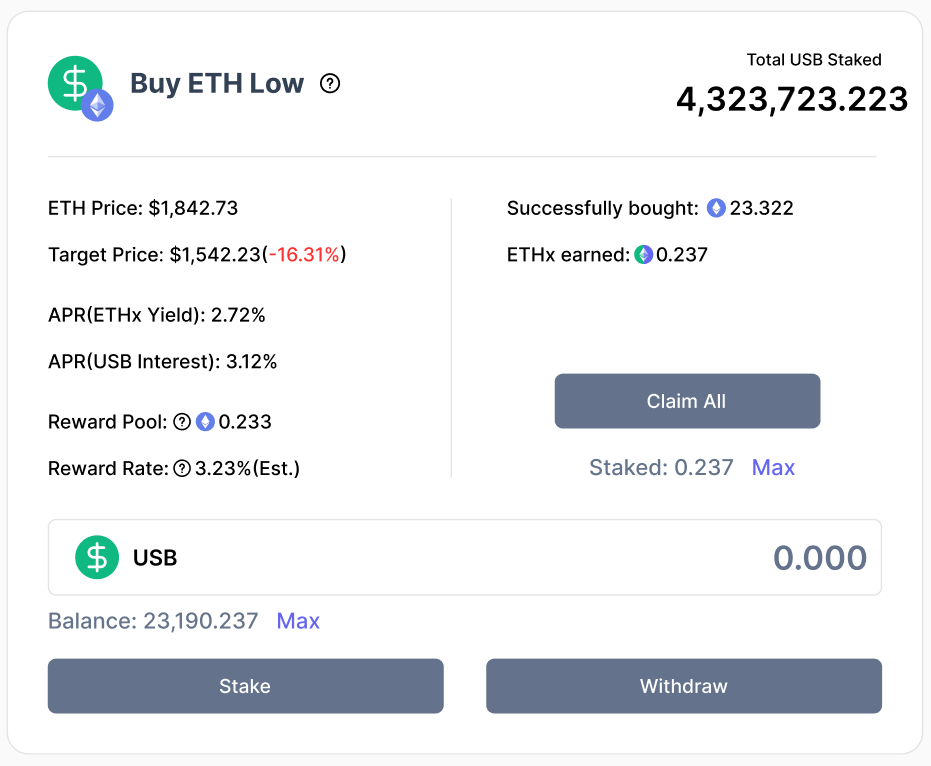
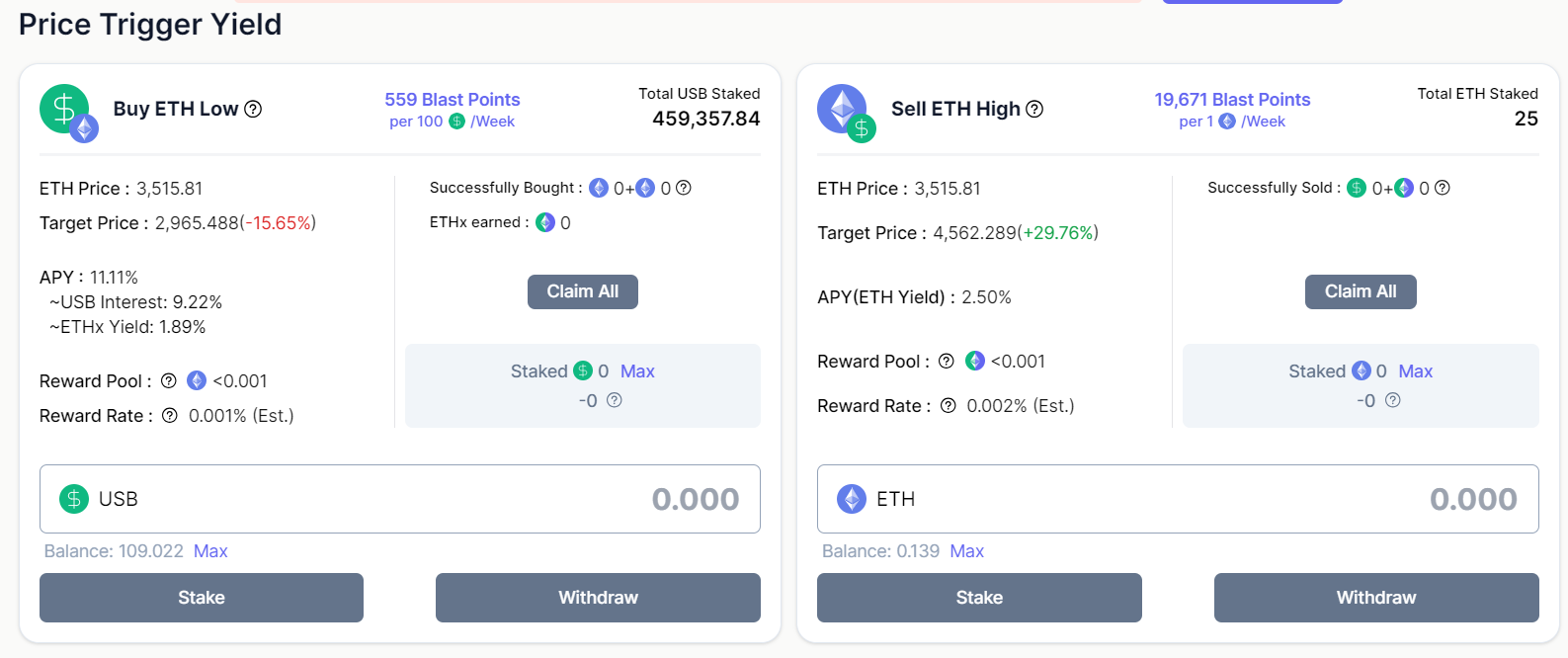
'Buy Low' means that users can stake USB and agree to buy ETH at a price lower than the market. Users will get a high yield during staking. When the ETH market price drops to the target, the staked USB will totally or partially be converted into ETH.&#x20;

<figure><img src="https://669798271-files.gitbook.io/~/files/v0/b/gitbook-x-prod.appspot.com/o/spaces%2FdP2GPddVCO37jH5cWj61%2Fuploads%2FoOAvH7nFN52n5H6IRVZ6%2Fimage.png?alt=media&amp;token=992456bc-c632-4c0e-975c-0586604a1a8c" alt="" width="375"><figcaption></figcaption></figure>

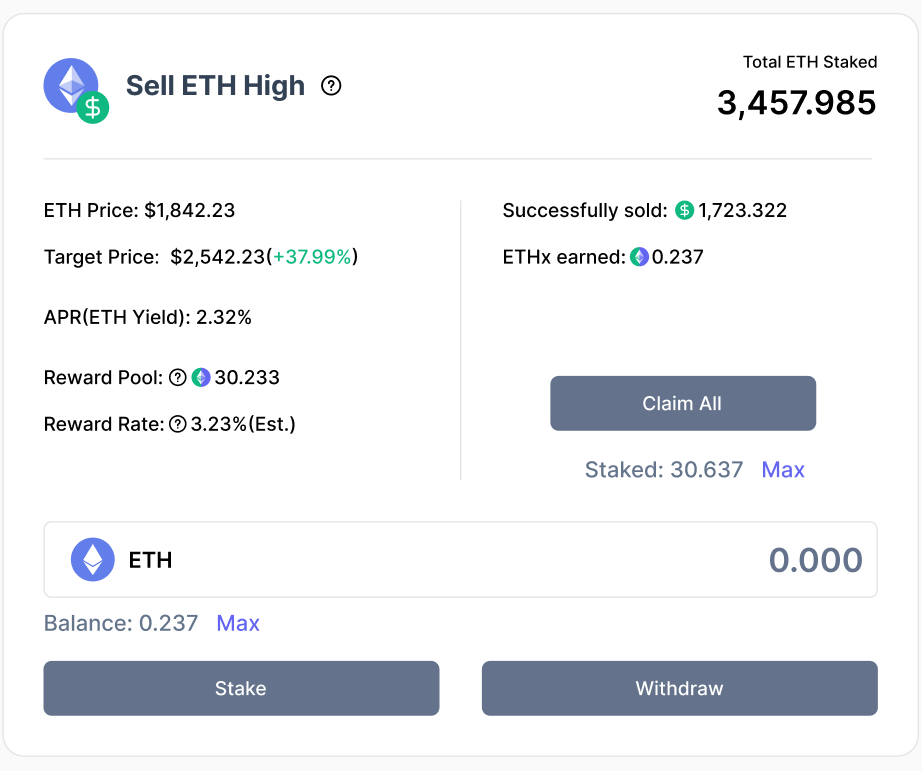
'Sell High' means that users can stake ETH and agree to sell ETH at a price higher than the market. Users will get a high yield during staking. When the ETH market price rises to the target, the staked ETH will totally or partially be converted into USB.&#x20;

<figure><img src="https://669798271-files.gitbook.io/~/files/v0/b/gitbook-x-prod.appspot.com/o/spaces%2FdP2GPddVCO37jH5cWj61%2Fuploads%2FB5QC5GeqG3EyO6r28KrF%2Fimage.png?alt=media&amp;token=3bdfe69d-2397-49b4-b215-5aa8cd214f8a" alt="" width="375"><figcaption></figcaption></figure>

{% hint style="warning" %}
S-Vault does not have this feature.
{% endhint %}

<br>


# Discount Offer

**'Discount offer' is a mechanism that is only activated in Adjustment Mode.** In this mechanism, users can purchase margin tokens like ETHx using USB, and when AAR is lower than AART, the discount for purchases gradually increases over time. It is a Dutch auction-based exchange.

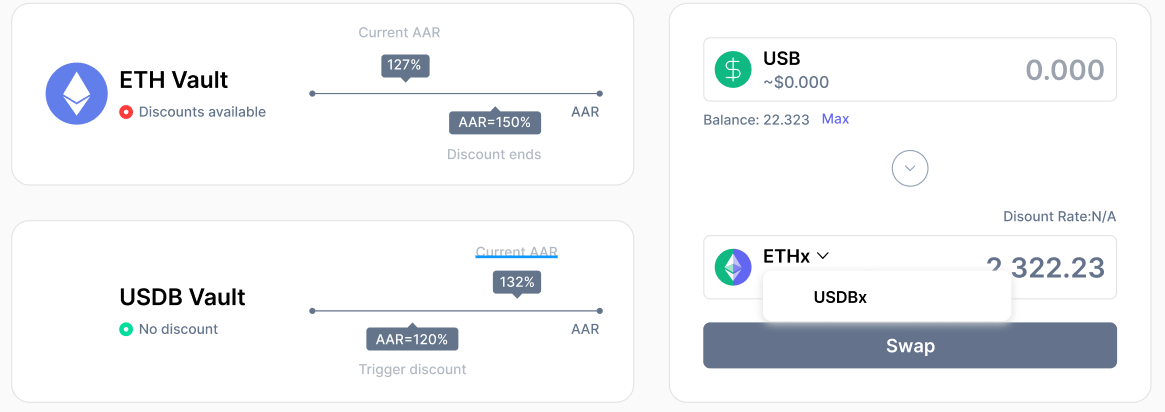
<figure><img src="https://669798271-files.gitbook.io/~/files/v0/b/gitbook-x-prod.appspot.com/o/spaces%2FdP2GPddVCO37jH5cWj61%2Fuploads%2FRk4kdxwRh9flF6GQxGgw%2Fimage.png?alt=media&amp;token=12c2b971-b7eb-40f8-af41-9cd767c2ae49" alt=""><figcaption></figcaption></figure>

***

**For the V-Vault, let's take the ETHx discount offer as an example:**

* In the Adjustment Mode,  when AAR is between 101% and AART, the formula for trading ETHx with USB is:

$$\Delta ETHx = \frac{\Delta USB \times M\_{ETHx}}{M\_{ETH} \times P\_{eth} - M\_{USB-ETH}} \times (1 + r)$$

Where ( r ) is the compensation coefficient, which gradually increases over time.&#x20;

{% hint style="warning" %}
Additionally, to prevent extreme volatility risks, when the AAR falls below 110%, the 'Discount offer' will be paused for half an hour, and it will resume after one hour.
{% endhint %}

* When AAR falls below 101%, the formula for trading ETHx with USB changes to:

$$\Delta ETHx = \frac{\Delta USB \times M\_{ETHx} \times 100}{M\_{USB-ETH}}$$

* When AAR rises over AART, it enters Stability Mode, and the discount offer ends.

***

**For the S-Vault, let's take the USDBx discount offer as an example:**

* When AAR falls below AARS, the formula for trading USDBx with USB is:

$$\Delta USDBx = \frac{\Delta USB \times M\_{USDBx}}{M\_{USDB} \times P\_{usdb} - M\_{USB-USDB}} \times (1 + r)$$

Where ( r ) is the compensation coefficient, which gradually increases over time.&#x20;

* When AAR falls below 101%, the formula for trading USDBx with USB changes to:

$$\Delta USDBx = \frac{\Delta USB \times M\_{USDBx} \times 100}{M\_{USB-USDB}}$$

* When AAR rises over AARS, it enters Stability Mode, and the discount offer ends.


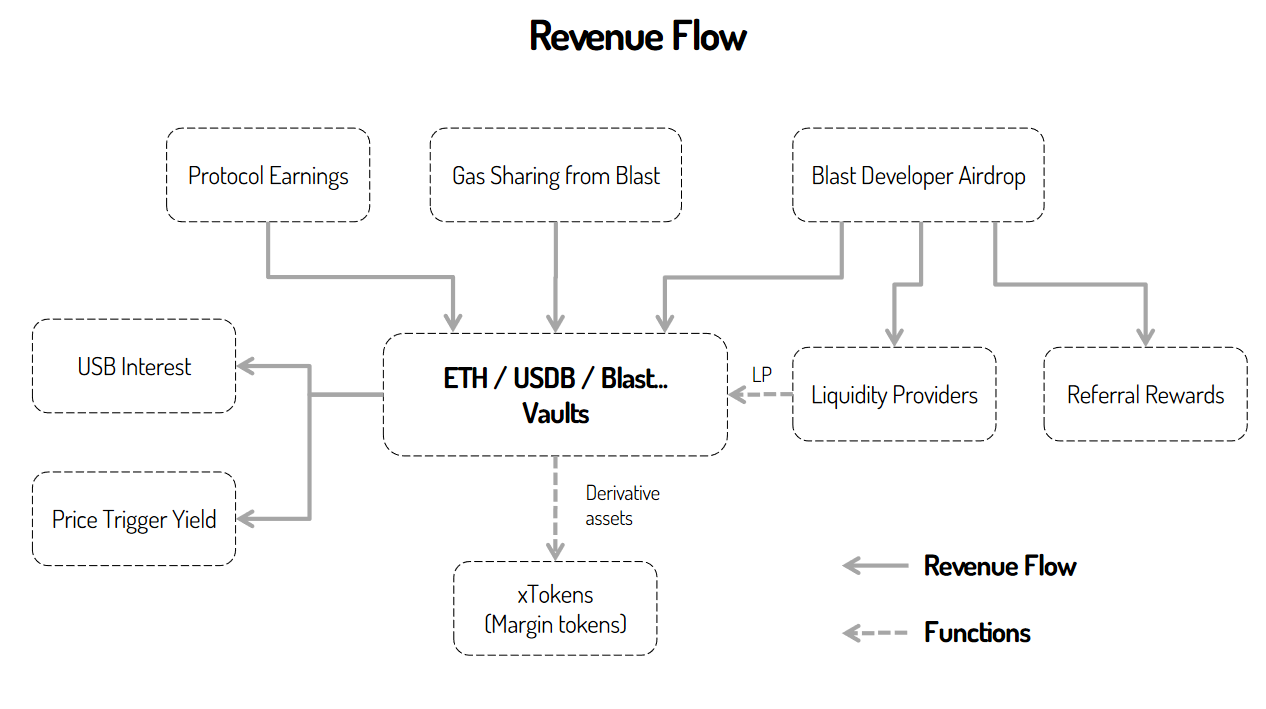
# Revenue Flow

<figure><img src="https://669798271-files.gitbook.io/~/files/v0/b/gitbook-x-prod.appspot.com/o/spaces%2FdP2GPddVCO37jH5cWj61%2Fuploads%2F0VYCtyl4Qy4kT443qcGA%2Fimage.png?alt=media&amp;token=33461d01-cb8e-43f0-a33b-db67659ea7f2" alt=""><figcaption></figcaption></figure>


# Parameters

These are the initial parameters, which can be changed in the future through DAO governance.

<table><thead><tr><th width="267">Item</th><th width="211">Code</th><th width="389">Value</th><th data-hidden>Range</th></tr></thead><tbody><tr><td>Financing Interest</td><td>y_ETH</td><td>=DSR(DAI Savings Rate)</td><td>0 - 100%</td></tr><tr><td></td><td>y_USDB</td><td>=DSR/2 </td><td>0 - 100%</td></tr><tr><td>Target AAR</td><td>AART_ETH</td><td>165%</td><td>100% - 1000%</td></tr><tr><td>Safety AAR</td><td>AARS_ETH</td><td>130%</td><td>100% - 1000%</td></tr><tr><td></td><td>AARS_USDB</td><td>115%</td><td>100% - 1000%</td></tr><tr><td>Upper AAR</td><td>AARU_ETH</td><td>200%</td><td>100% - 1000%</td></tr><tr><td>Circuit Breaker AAR</td><td>AARC_ETH</td><td>110%</td><td>100% - 1000%</td></tr><tr><td>Redemption fee</td><td>C</td><td>0.5%</td><td>0-10%</td></tr><tr><td>Compensation Coefficient</td><td>r</td><td>+0.001 per hr</td><td>0-1</td></tr></tbody></table>


# RedStone Oracles

We utilize RedStone price feeds for price information, AAR calculation, and rebalance thresholds.

RedStone is a Modular Oracle delivering token pricing by fetching price feeds from off-chain sources (CEXes, aggregators) and on-chain sources (DEXes).&#x20;


# Audit Report

Audited by Beosin.

<https://github.com/wandfi/resources/blob/main/audits/Beosin_202403.pdf>


# Addresses

Blast Point Operator: 0x98835361d3032E48eB140B3B610885e5bAd6C5f1

## Version 2.0

#### ETH Vault V2

* **Vault**: [0x691867213C0d43C167E7C035e489Ae36F3286141](https://blastscan.io/address/0x691867213C0d43C167E7C035e489Ae36F3286141)
* **TokenPot**: [0x7063ea2dBa364aCd9135752Da5395ac7CD12313D](https://blastscan.io/address/0x7063ea2dBa364aCd9135752Da5395ac7CD12313D)
* **ETHx**: [0xd79d6Fe06F4C2b17291015169d1443f50D0C2838](https://blastscan.io/address/0xd79d6Fe06F4C2b17291015169d1443f50D0C2838)
* **PtyPoolBuyLowV2**: [0x3ee083573FceA8c015dcbfC7a51777B5770cbe64](https://blastscan.io/address/0x3ee083573FceA8c015dcbfC7a51777B5770cbe64)
* **PtyPoolSellHighV2**: [0x39db7083C97d2C298C1A88fD27b0bd1C9c9f6fa8](https://blastscan.io/address/0x39db7083C97d2C298C1A88fD27b0bd1C9c9f6fa8)
* **PriceFeed**: [0x44a0dDd7E2C76FD4DC4327E5e16d967869422F9A](https://blastscan.io/address/0x44a0ddd7e2c76fd4dc4327e5e16d967869422f9a)

#### USDB Vault V2

* **Vault**: [0xfdB3e621ea5F869d70E99C4CBB6F77e5D2Efd93b](https://blastscan.io/address/0xfdB3e621ea5F869d70E99C4CBB6F77e5D2Efd93b)
* **TokenPot**: [0x565e325B7197d6105b0Ee74563ea211Cc838e2c3](https://blastscan.io/address/0x565e325B7197d6105b0Ee74563ea211Cc838e2c3)
* **USDBx**: [0x836aED3b0E0ee44C77e0b6Db34D170AbCCe9BaAC](https://blastscan.io/address/0x836aED3b0E0ee44C77e0b6Db34D170AbCCe9BaAC)
* **PriceFeed**: [0xb4bB26cc7D36d6045432d89FC525b8adEe269ad8](https://blastscan.io/address/0xb4bB26cc7D36d6045432d89FC525b8adEe269ad8)

## Version 1.0

$ETH vault token pot: <https://blastscan.io/address/0xDC3985196D263E5259AB946a4b52CEDCBaDC1390>

$ETH vault pty pool buy low: <https://blastscan.io/address/0xfD7D3d51b081FBeA178891839a9FEd5ca7896bDA&#x20>;

$ETH vault pty pool sell high: <https://blastscan.io/address/0x2F5007df87c043552f3c6b6e5487B2bDc92F0232&#x20>;

$USDB vault token pot: <https://blastscan.io/address/0x05c061126A82DC1AfF891b9184c1bC42D380a2ff>


# Migration to V2

To enhance interoperability and support a wider range of assets in the future, we have decided to upgrade the vault to version 2.0.

## Token Addresses

<table><thead><tr><th width="127">Token</th><th>V1</th><th>V2</th></tr></thead><tbody><tr><td>ETHx</td><td>0x5A7651Dd5C9d72fc4FDD4f9706193F33DFb4122d</td><td>0xd79d6Fe06F4C2b17291015169d1443f50D0C2838</td></tr><tr><td>USDBx</td><td>0xF0DBd77230d0a6F6dd40D81417Bc5759d2Ca2C27</td><td>0x836aED3b0E0ee44C77e0b6Db34D170AbCCe9BaAC</td></tr><tr><td>USB</td><td>No change</td><td></td></tr></tbody></table>

## Preparation

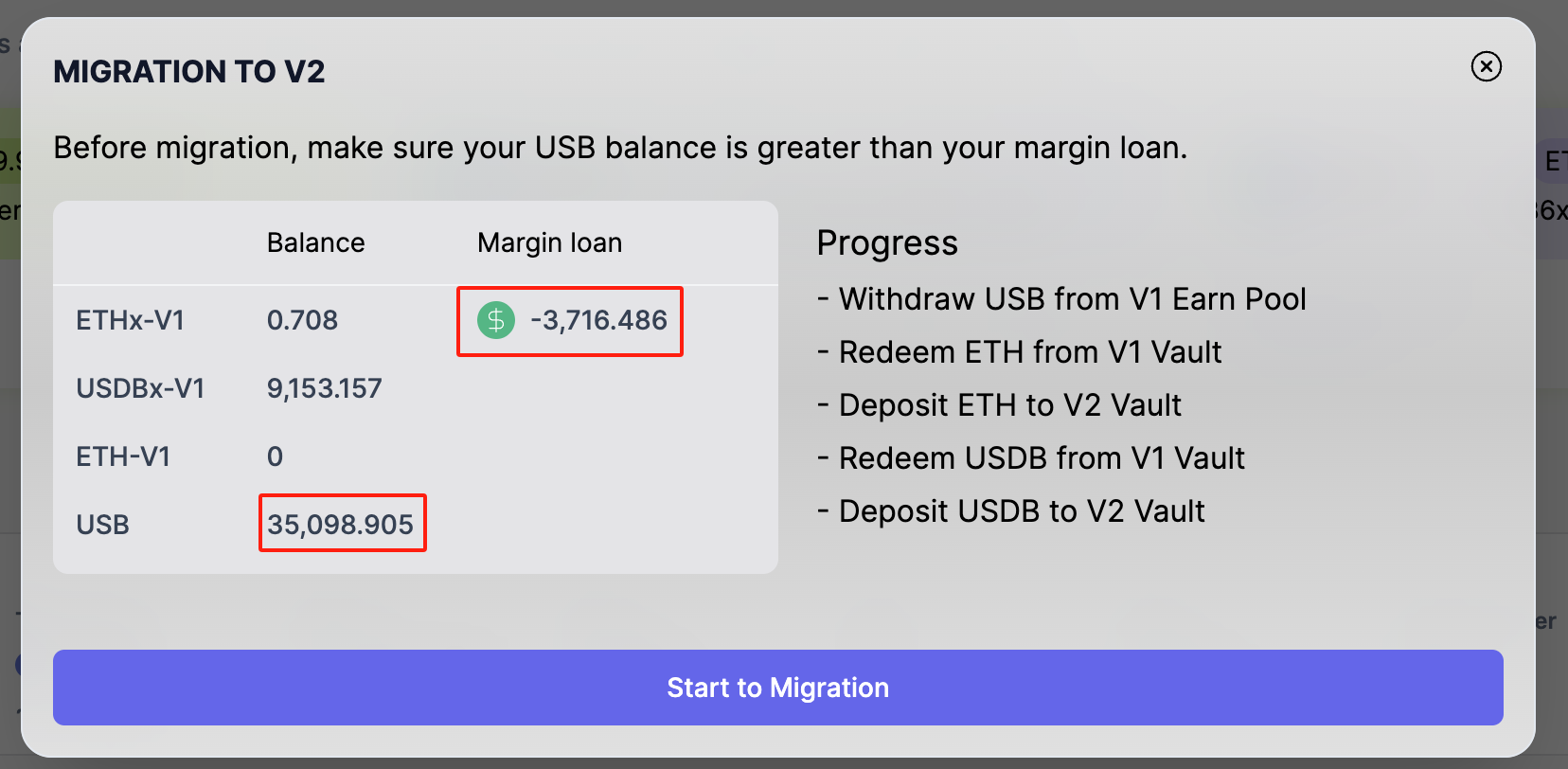
1. Remove the LP on Dexes;
2. Keep your USB balance bigger than your Margin Loan;

<figure><img src="https://669798271-files.gitbook.io/~/files/v0/b/gitbook-x-prod.appspot.com/o/spaces%2FdP2GPddVCO37jH5cWj61%2Fuploads%2FQXgNtPn6HDPHF5clZiw8%2Fimage.png?alt=media&amp;token=3d497ffb-8ffa-4dd5-baa8-e6a4d68d9006" alt=""><figcaption></figcaption></figure>

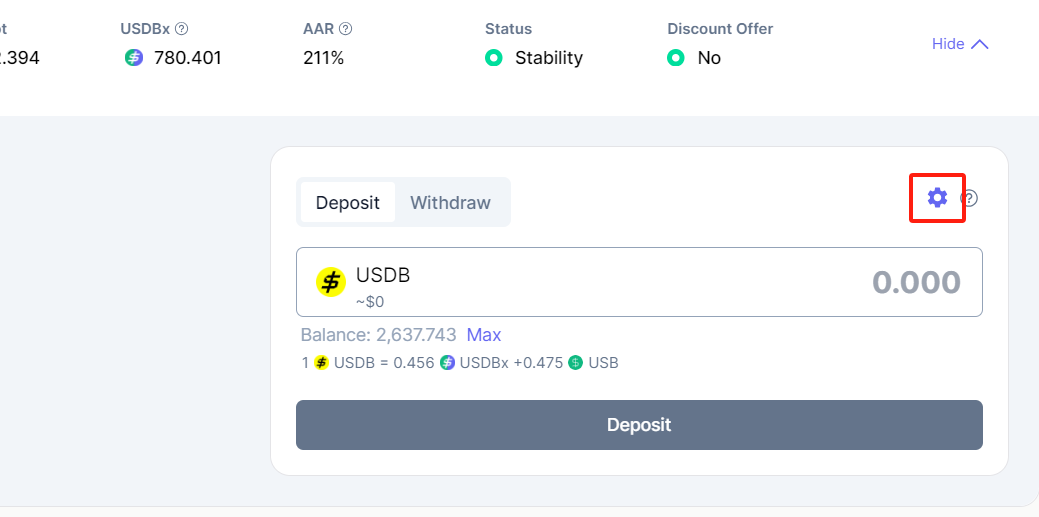
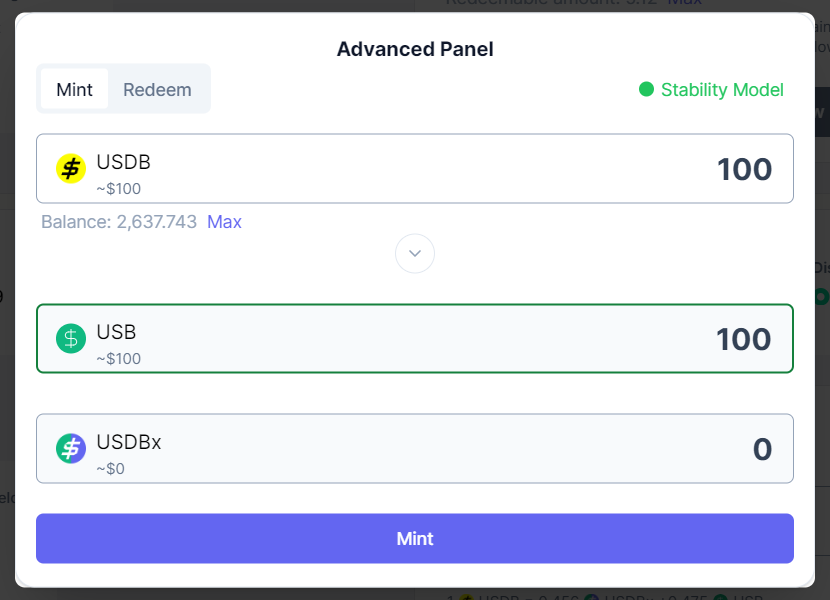
If your USB balance is insufficient, please mint some USB in the USDB v2 vault. You can use the advanced panel to mint USB individually, without generating USDBx.

<figure><img src="https://669798271-files.gitbook.io/~/files/v0/b/gitbook-x-prod.appspot.com/o/spaces%2FdP2GPddVCO37jH5cWj61%2Fuploads%2FOERnDsDyIy4uJ5MzmHex%2Fimage.png?alt=media&amp;token=c0d68f23-337b-44e1-867d-893cdffc491c" alt=""><figcaption></figcaption></figure>

<div data-full-width="true"><figure><img src="https://669798271-files.gitbook.io/~/files/v0/b/gitbook-x-prod.appspot.com/o/spaces%2FdP2GPddVCO37jH5cWj61%2Fuploads%2FhhwCS1ekBXgR4mDcqTfQ%2Fimage.png?alt=media&amp;token=0dd97219-a00b-409b-9bd3-cfcc89bdb106" alt="" width="375"><figcaption></figcaption></figure></div>

## Migration

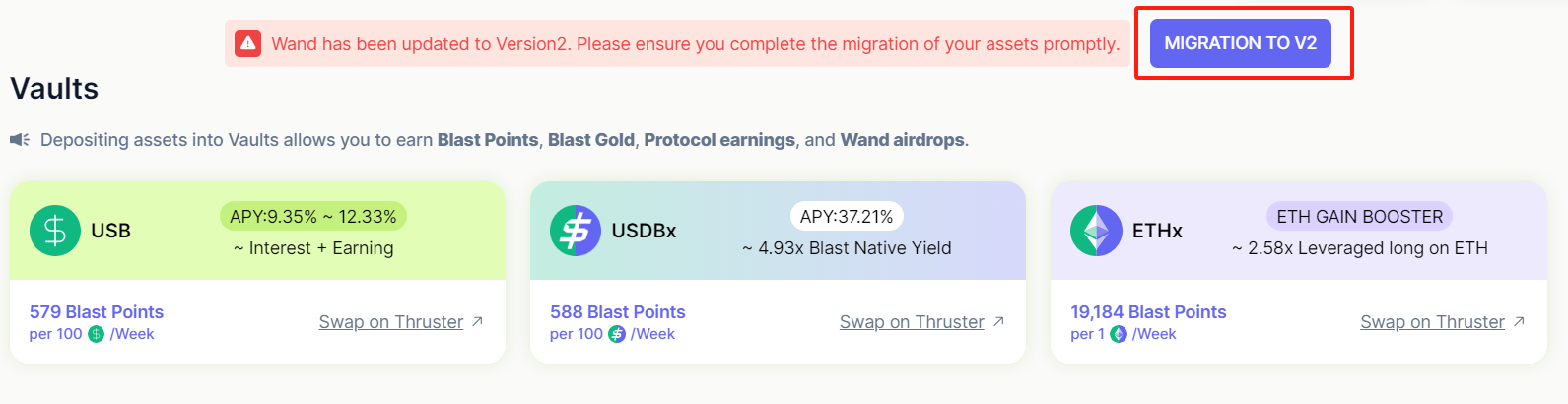
1. Click the button to open the migration panel:

<figure><img src="https://669798271-files.gitbook.io/~/files/v0/b/gitbook-x-prod.appspot.com/o/spaces%2FdP2GPddVCO37jH5cWj61%2Fuploads%2FswMsx46Fv9YxQBwmsC7s%2Fimage.png?alt=media&amp;token=918ad2ed-6d47-4e05-930d-3de2b2de3227" alt=""><figcaption></figcaption></figure>

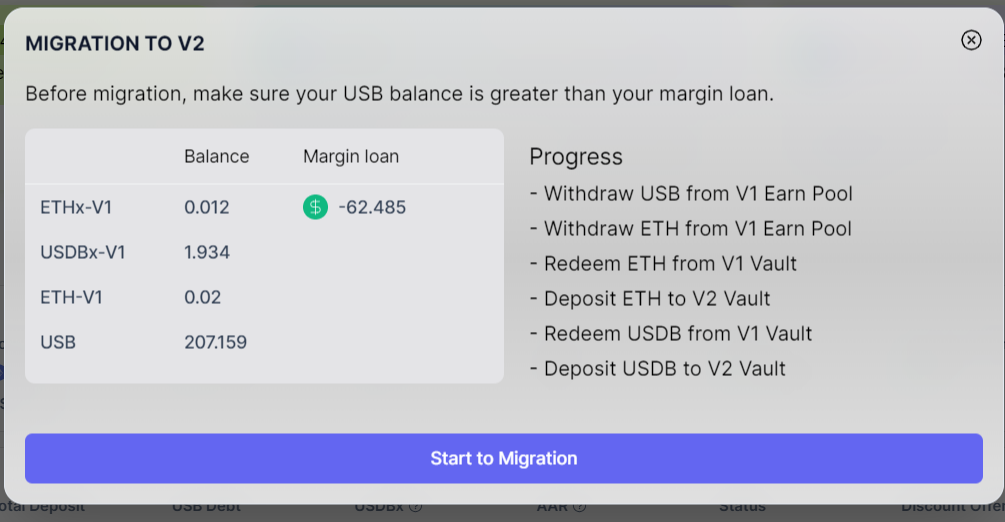
2. Click "Start to migrate"

<figure><img src="https://669798271-files.gitbook.io/~/files/v0/b/gitbook-x-prod.appspot.com/o/spaces%2FdP2GPddVCO37jH5cWj61%2Fuploads%2F3rmycteCQkGMWFIAQWKV%2Fimage.png?alt=media&amp;token=f6a6a403-3aa9-4f12-8e64-1be464dbf02b" alt=""><figcaption></figcaption></figure>

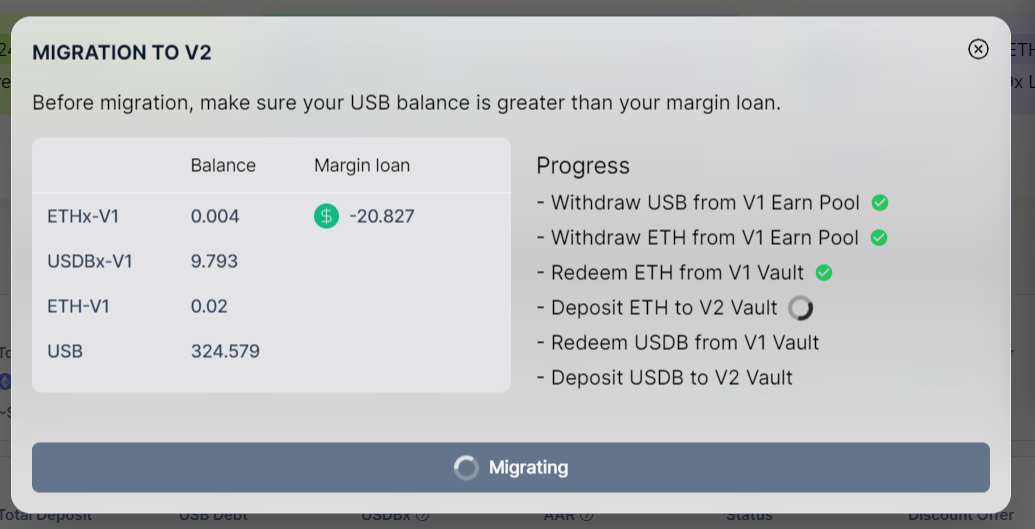
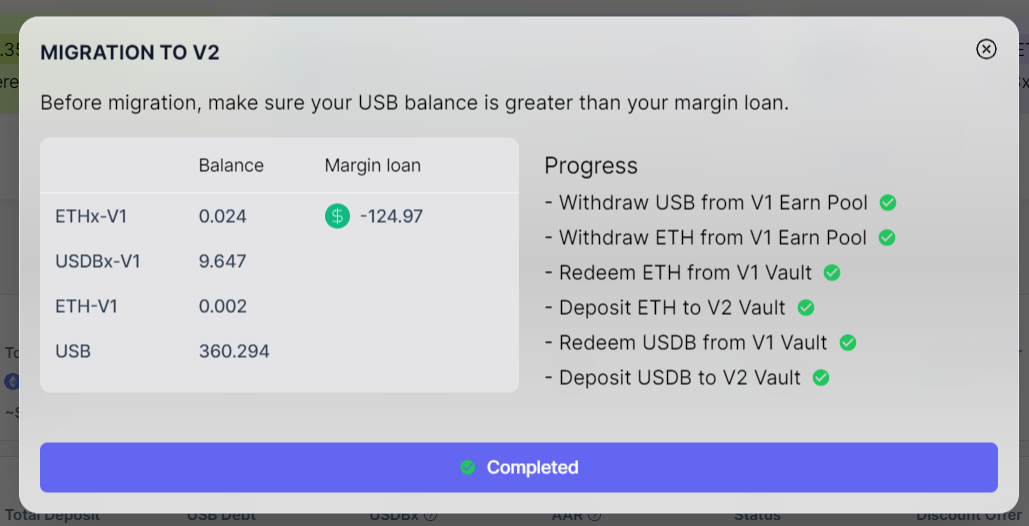
3. Simply sign according to the progress to complete the migration **with no redemption fees**. **DO NOT CLOSE THE WINDOW BEFORE COMPLETION.**

<figure><img src="https://669798271-files.gitbook.io/~/files/v0/b/gitbook-x-prod.appspot.com/o/spaces%2FdP2GPddVCO37jH5cWj61%2Fuploads%2FQKc812QaM2JRNpWoN1bA%2Fimage.png?alt=media&amp;token=bec29742-7ec2-4717-895e-41c7b66118e7" alt=""><figcaption></figcaption></figure>

<figure><img src="https://669798271-files.gitbook.io/~/files/v0/b/gitbook-x-prod.appspot.com/o/spaces%2FdP2GPddVCO37jH5cWj61%2Fuploads%2FBMrcLO1yAYxJ7nBzPmlU%2Fimage.png?alt=media&amp;token=7e88cd9d-ae83-4460-a760-ff836959fe30" alt=""><figcaption></figcaption></figure>

4. After the migration, if you wish to participate in Earn, you must manually stake your USB and ETH.

<figure><img src="https://669798271-files.gitbook.io/~/files/v0/b/gitbook-x-prod.appspot.com/o/spaces%2FdP2GPddVCO37jH5cWj61%2Fuploads%2FNtRdHZklXAA7JDCO9R4A%2Fimage.png?alt=media&amp;token=db188d4d-2212-4d35-8ef2-98aa3a5c68aa" alt=""><figcaption></figcaption></figure>


# Guide 101


# What can I do with Wand?

Wand is an innovative lending protocol that introduces the concept of pooled CDP. In addition to stablecoins, it also generates margin tokens, catering to the needs of various investors.

Here are some example scenarios:

## Scenario1--Stablecoin users

Alice is a stablecoin user who holds USB. Every day, USB generates interest, which is automatically added to Alice's account balance.&#x20;

Additionally, Alice can stake her USB in the "Buy ETH Low" pool to earn farming yield given by Wand protocol. When the price of ETH drops to the target price, Alice's staked USB automatically buys ETH at the target price with an additional discount.

&#x20;Furthermore, when the 'Discount offer' is available, Alice can buy Margin tokens at a discount using USB, gaining arbitrage profits.

## Scenario2--Liquidity releasing

Bob is an ETH holder who needs money to purchase another token, but he does not want to sell his ETH. In this case, Bob deposits his ETH into the ETH vault, receiving stablecoins and margin tokens in return. These margin tokens represent his long position on ETH.

Bob uses the stablecoins to buy the token he wants and, after some time, sells it for a profit. After repaying his debts, Bob burns the margin tokens and redeems the ETH he initially deposited. Thanks to the earnings of the Vault during this time, Bob ends up redeeming even more ETH than he initially deposited.&#x20;

In the end, Bob has lent out liquidity to earn trading profits while also ending up with more ETH.

## Scenario3--Leverage trading

Charlie is a risk-appetite investor. After observing a period of decline in ETH prices, he believes that the market has reached the bottom and wants to buy into ETH to earn investment returns. However, Charlie's funds are only sufficient to purchase 10 ETH, and he is not satisfied with this position size. So, he uses his funds to buy ETHx on Wand, which is a margin token for ETH with a 3X leveraged long ratio. This increases Charlie's long position on ETH to the equivalent of 30 ETH.

After some time, as the price of ETH rises, Charlie's profits are amplified 3X compared to spot trading, significantly increasing his investment returns.


# How to obtain xToken and USB?

You can obtain USB and xToken in two ways.&#x20;

The first way is to directly mint them through Wand, with specific rules detailed in the [Vault](/products/collateral-vault/vault).

The second way is to obtain them through trading on the secondary market. Wand will promptly establish collaborations with Dex and provide liquidity.


# FAQ

## 1. What is Wand?

Wand is a structured asset protocol that maximizes asset utilization by introducing a pooled CDP model, enhancing liquidity in the DeFi space.

## 2. Can you further explain pooled CDP?

Unlike traditional CDP models where each user's CDP causes over-collateralized values to vary, Wand introduces a pooled CDP model. Everyone shares a common CDP, making over-collateralized values uniform and enhancing liquidity across the board.

## 3. How to maximize the utilization?

In a traditional CDP model, for example, MakerDao, when a user deposits ETH as collateral, they can borrow stablecoins up to a certain percentage of the collateral’s value to achieve liquidity, leaving the over-collateralized portion idle and unused. Wand innovatively allows users to mint the over-collateralized part into a margin token, ensuring that 100% of the collateralized value is brought into circulation and maximizing liquidity. This ensures that not only the borrowed stablecoins but also the over-collateralized portion are put to productive use in the DeFi ecosystem, enhancing overall asset utilization and efficiency.

## 4. Can I withdraw my ETH?

Yes, you can redeem your ETH. Within the Wand, a redemption mechanism allows you to convert your assets (such as USB and xToken) back into collateral, which in this case is ETH.&#x20;

## 5. What assets does Wand support?

Initially, Wand supports ETH and USDB. Additionally, we plan to introduce more assets in the future such as WBTC.

## 6. How does Wand manage risks, especially when collateral prices drop?

Pooled CDPs also encounter risks when collateral prices fall. To manage this, we use the Asset Adequacy Ratio (AAR) to assess the vault's health. A high AAR lowers the leverage ratio of Margin Tokens, whereas a low AAR suggests a risk of debt repayment for USB. Thus, maintaining the AAR balance is crucial.

Unlike traditional lending protocols, Wand does not enforce liquidations. Instead, it introduces an Adjustment mode, Price Trigger Yield, and Discount offer mechanism to dynamically adjust the AAR. This allows anyone to participate and potentially earn arbitrage profits, ensuring the Vault's health.

## 7. Can I trade ETHx?

Yes, assets generated by Wand Protocol, including the over-collateralization which is minted into a margin token, can be traded as they conform to the ERC-20 standard, ensuring they are interoperable with various DeFi platforms.

## 8. Will my open position change?

Your held margin tokens represent your open position in the vault. When the Vault is in Stability Mode, maintaining the same number of your margin tokens will keep your position unchanged.

However, when the Vault is in Adjustment Mode, your position may experience slight variations. If you wish to maintain a constant position, you can actively manage it during the adjustment period by buying or selling margin tokens to keep your position stable.


# Coming soon


# Blast Campaign


# Basic Rules

Wand Points System is designed to reward loyal users with an invitation code. Users can obtain Wand points through the early access campaign.

Potential distributions will refer to the points system. In the first phase, **100%** of Blast rewards including  [Blast Points](/archived/blast-campaign/blast-points)and [Blast Gold](/archived/blast-campaign/blast-gold) obtained by Wand will be distributed to users based on Wand Points.


# Blast Points

Since November 20th, EOAs that have bridged ETH/USD to the Blast launch bridge have earned points proportional to their balance over time.

When ETH/USD is transferred to Wand, Wand will earn points proportional to the ETH/USD balance over time. These Blast Points will be temporarily stored and distributed proportionally to users based on their TVL contributions.

Users **WILL NOT** lose their original Blast Points when participating in Wand.


# Blast Gold

Once the Mainnet goes live, Blast Gold will be manually distributed to smart contracts over time. Wand will reward 100% of the Blast Gold to our users based on Wand Points, with the specific rules as follows:

## Wand Points

Wand points consist of two parts: "My contribution" and "From invitees" .

### Rules of Contribution Points

1. Users who participated in the Blast Early Access Campaign before March 1st will receive initial points of 200.
2. Users who participated in the [Galxe Blast Takeover Campaign](https://galxe.com/Wand/campaign/GCd2AtwEh3) will receive initial points of 500.
3. After the mainnet launch, users will receive corresponding points for their contribution.
4. Contributions include TVL, Transactions, Liquidity Providing, Community Promotion, and Feedback during the Testing Phase. Adjustments will also be made on time to align with Blast's Gold distribution rules.

### Rules of Invitation Rewards

Users can invite friends to participate in the campaign using an invitation code. The inviter will receive an additional 10% of the invitee's total points as a reward.

The first batch of invitation codes is generated from a whitelist.

## Boost from Quests

The points of users who complete Quests will receive a boost. Wand will periodically release new Quests, please stay tuned.